In the fast-changing world of digital content creation, writers often face the challenge of producing quality content quickly and consistently. This is where prompt engineering comes into play—a skill that’s becoming essential for content writers leveraging AI tools like ChatGPT or Gemini. From brainstorming creative ideas to optimizing SEO-focused articles, prompt engineering helps writers unlock the full potential of AI-assisted writing. In this article, I’ll share how prompt engineering has helped me—and can help you—excel in your writing career.
What Is Prompt Engineering and Why It Matters
Prompt engineering is the art and science of crafting effective instructions, or “prompts,” to guide AI tools in generating relevant, high-quality, and accurate text outputs. Instead of typing vague requests like “write a blog post,” content writers can use a carefully designed prompt that includes context, style, and goals—for example, “Write a 1,000-word article for small business owners explaining why local SEO is crucial.” The result? Sharper, more targeted content that resonates with readers.
The reason prompt engineering matters is because AI tools are only as good as the instructions they receive. When you give a poorly structured prompt, you often get vague or irrelevant responses. But with clear guidance, you can direct the AI to produce well-aligned content that fits your tone, audience, and SEO goals. Think of it as being a conductor of an orchestra—you control the cues, and the AI performs beautifully when it understands your intent.
From my personal experience, after improving my prompts, I noticed a dramatic shift in quality. My articles started to match brand voice more consistently and required fewer edits. For instance, when writing for a fashion blog, I started prompting the AI with “use a conversational tone and focus on emotional connection” rather than just “write about summer trends.” The difference in engagement was immediately noticeable.
Ultimately, prompt engineering isn’t about replacing creativity; it’s about amplifying it. By mastering prompts, writers can save hours of research and revision time while maintaining originality and SEO performance.
How Prompt Engineering Boosts Writing Quality
Well-structured prompts help writers get AI-generated drafts that already meet about 70–80% of editorial requirements. This allows writers to focus more on refining ideas and injecting personal insights instead of fixing structural issues or irrelevant details. In my own workflow, I use prompts that include target audience details, formatting preferences, and SEO keywords—all in one command. This ensures the initial draft needs minimal adjustment.
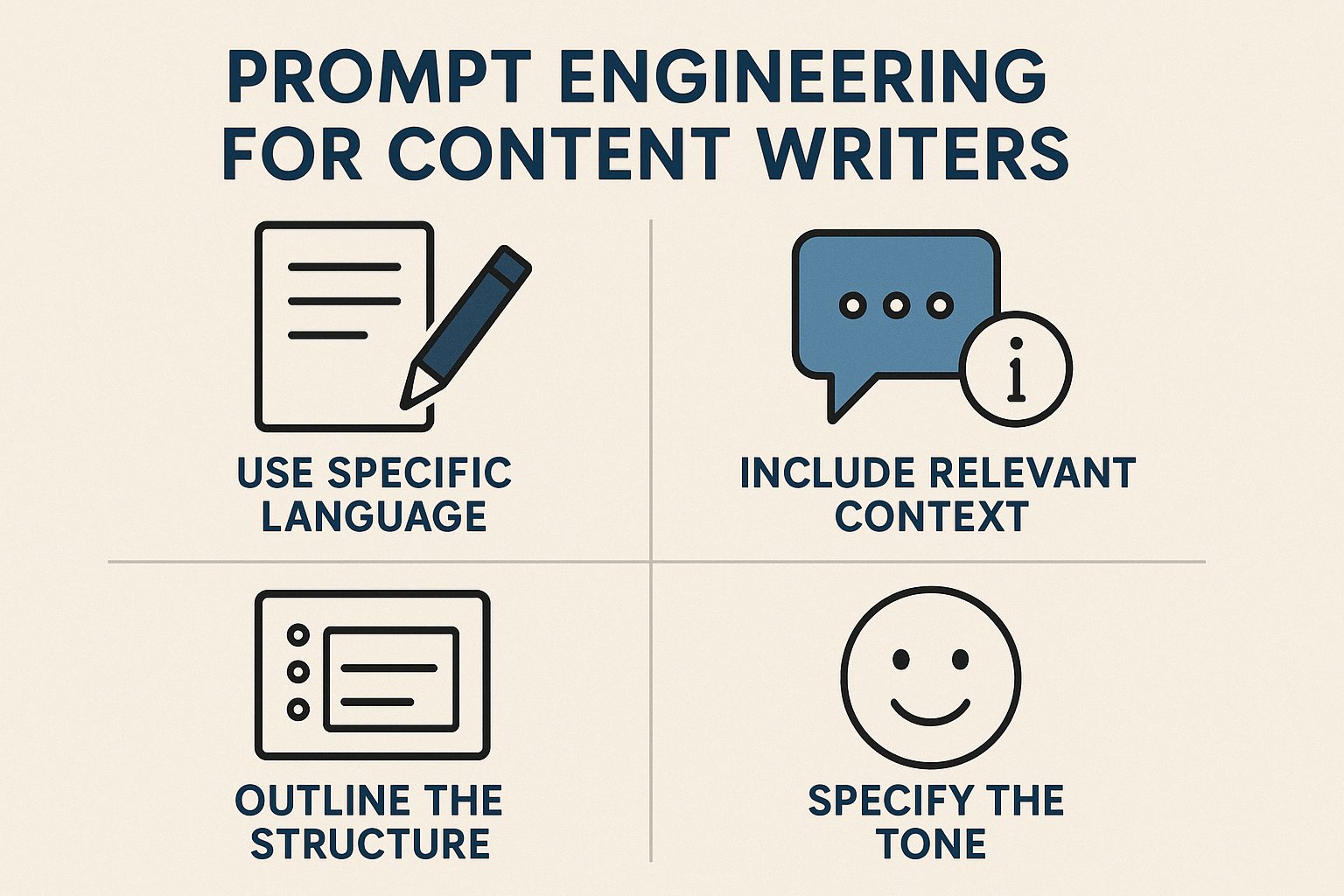
Prompt engineering also helps maintain brand voice consistency across multiple pieces of content. If your client or company has a specific tone—be it professional, friendly, or authoritative—you can specify that in the prompt. For example, “Use an expert yet approachable tone suitable for tech-savvy entrepreneurs.” With this guidance, the AI produces text that aligns with your or your client’s brand identity.
Another major benefit is SEO optimization. By including keywords, content intent, and formatting structures like bullet points and subheadings in your prompts, you’ll generate articles ready to perform well in search results. I’ve found that prompting the AI to “include long-tail keywords with moderate competition” produces content that appeals to Google’s algorithms while avoiding excessive keyword stuffing.
Lastly, quality control becomes much easier. When you consistently use strong prompts, you can predict the outcomes more reliably. Over time, you’ll refine a set of “prompt templates” that work best for different types of content—blogs, product descriptions, or social media posts—ensuring both speed and precision.
Tips to Use Prompt Engineering for Better Content
If you’re new to prompt engineering, start with specificity. The more details you give, the better your results. Mention your audience, tone, structure, and purpose. For instance, instead of “write about prompt engineering,” say: “Write a detailed, SEO-optimized blog post explaining how prompt engineering helps freelance writers improve efficiency.” This precision communicates expectations clearly to the AI.
Next, consider using iterative prompting. Don’t expect perfection in one go. Start broad, then refine. I often ask AI to “outline the main points,” then follow up with “expand paragraph two with real-world examples.” This step-by-step approach helps maintain logical flow and ensures authenticity.
Another tactic is contextual prompting, where you feed the AI relevant information or examples to build upon. If you’re writing a case study, you can input background data so the AI can tailor responses accurately. I once used this when creating a content strategy report for a tech startup—the final version was far more coherent and practical because the AI understood my dataset.
Finally, test and track your results. Keep note of which prompts yield the best engagement or SEO results. This ongoing analysis turns prompt creation into a repeatable, data-backed strategy.
The Future of Content Writing With AI Prompts
The future of content creation is undeniably tied to AI, and prompt engineering will be at the center of it. As AI models evolve, the ability to communicate effectively with them will distinguish top-tier writers from the rest. Writers who master this skill will not only produce high-quality content faster but also adapt effortlessly to new technologies and platforms.
I foresee a time when prompt engineering becomes part of every writer’s toolkit—just like keyword research or content strategy. It will merge creativity with technical understanding, allowing writers to function as both strategists and storytellers. Already, I see content teams developing “prompt libraries” to maintain consistency across campaigns.
There’s also a growing trend of AI co-creation, where writers collaborate with AI to brainstorm headlines, test variations of blog intros, and optimize calls to action. This dynamic partnership enhances productivity while keeping the creative direction firmly in human hands.
In short, prompt engineering represents a future where AI empowers, not replaces, content writers. It opens up unprecedented opportunities for scaling content without sacrificing quality or authenticity.
Q & A
Q: Can prompt engineering replace my creativity as a writer?
A: Not at all. Prompt engineering complements creativity by handling repetitive tasks and giving you better starting material—so you can focus on insight, storytelling, and emotional resonance.
Q: What tools do I need to practice prompt engineering?
A: Any AI writing assistant that accepts custom prompts will work—popular choices include ChatGPT, Jasper, and Writesonic. The key lies in mastering prompt structure rather than relying on a specific platform.
Prompt engineering is no longer just a buzzword—it’s a must-have skill for the next generation of content writers. By mastering this technique, you enhance not only your efficiency but also your content’s SEO performance, tone accuracy, and audience engagement. Combining human creativity with AI’s generative capabilities leads to richer, more impactful results. Start experimenting with prompts today, refine your process, and watch your writing career thrive in the age of intelligent content creation.
Leave a Reply